
Last week, I watched a very interesting panel discussion with Dr Stewart Desson, Louise Mowbray, Rohin Aggarwal, Kate Young and Gavin Howden titled AI: Talent & Development’s Saviour or Saboteur?
It raised some similar points to my last article about how AI might transform learning and development, highlighting that the power of AI is in doing the mundane work to free up humans to do the things that they can do better than AI, for example, to make decisions, coach and debate.
Kate Young and Louise Mowbray both made the point that we’re now past the point of debating whether AI will be a saviour or a saboteur, as it is already here and changing so much of our lives.
In her book, Relevant: Future-Focused Leadership, Louise Mowbray emphasises our agency in constructing the future, and asks:
“Are we actively pulling ourselves towards a world we want to live in or sitting on the sidelines as passive critics or accidental tourists?”
Afterwards, I found that Louise Mowbray’s book was available on Kindle Unlimited, so I decided that might be a good way to follow up on some of the ideas from the panel discussion.
Below is my summary of the first chapter, which focuses on the challenges of the present landscape, with our context constantly shifting, and the importance of context.
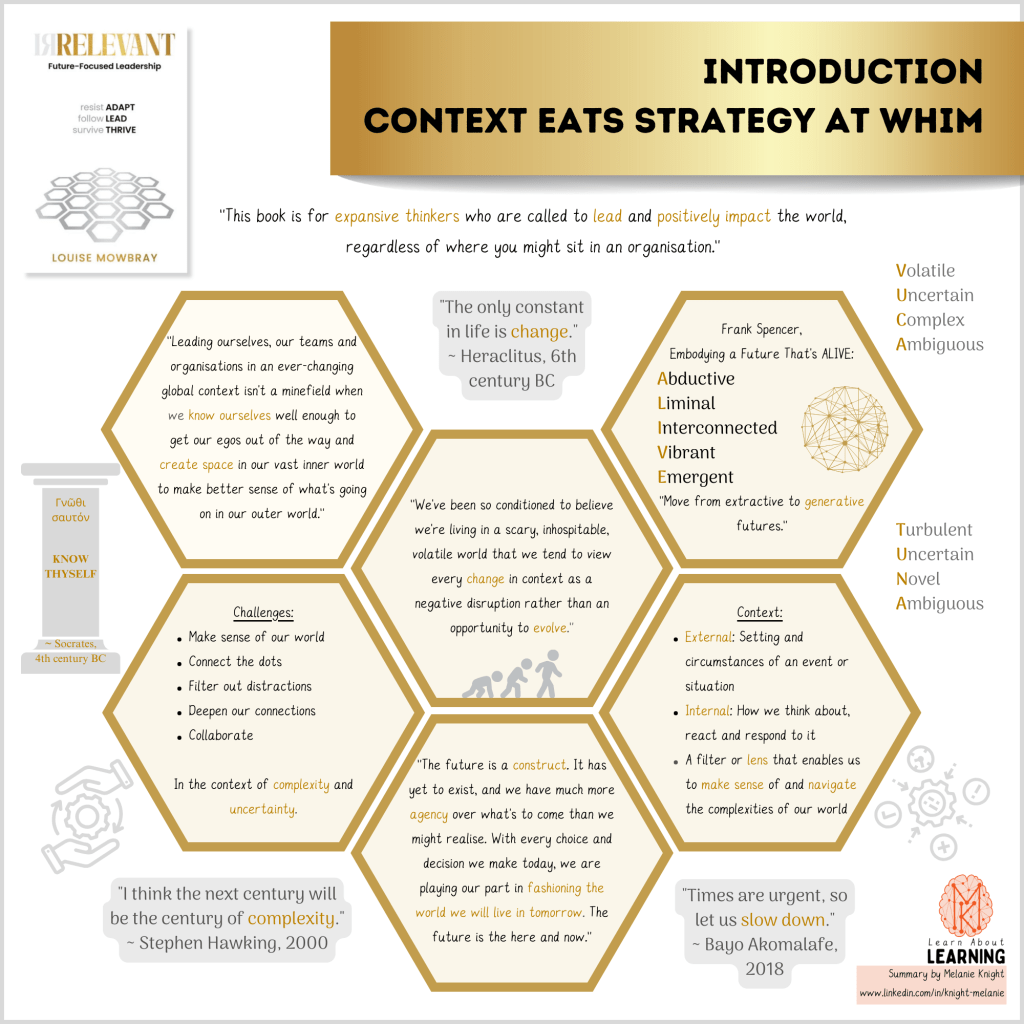
At first glance, a book about leadership didn’t seem very relevant to me, but the first sentence pulled me in:
“This book is for expansive thinkers who are called to lead and positively impact the world, regardless of where you might sit in an organisation.”
Change and uncertainty
Louise Mowbray talks about the pace, intensity and nature of external change being markedly different to what we have experienced in previous decades. It has been described by acronyms such as VUCA (Volatile, Uncertain, Complex and Ambiguous) and TUNA (Turbulent, Uncertain, Novel and Ambiguous).
She acknowledges the acute stress response that is produced by uncertainty.
“We’ve been so conditioned to believe we’re living in a scary, inhospitable, volatile world that we tend to view every change in context as a negative disruption rather than an opportunity to evolve.”
Sensemaking and complexity
The book highlights the challenges of making sense of our world, connecting the dots, filtering out distractions, deepening our connections and collaborating, within the context of increasing complexity and uncertainty.
However, Louise Mowbray brings an optimistic view:
“We need to fall in love with our prevailing context of complexity or at least make friends with it. It’s the natural order of humanity, our big, beautiful world and the universe. It’s awe-inspiringly fascinating, dynamic and yes — it’s also unpredictable.”
This echoes the perspective of Jeroen Kraaijenbrink in his article What BANI Really Means (And How It Corrects Your World View).
“It is not the world that has become more Brittle, Anxious, Non-Linear, or Incomprehensible. It us who finally have to let go the illusion that it is not. As such, BANI is one great reminder for all of us. We’re living in a world that’s delicate, uncontrollable, unpredictable and impossible to comprehend. Let’s celebrate, accept and wonder.”
Frank W. Spencer IV proposes an alternative acronym in his article:
“I propose that we acquaint ourselves with the idea of being ALIVE: Abductive, Liminal, Interconnected, Vibrant and Emergent. Those qualities may be very different from the ones that we are used to presenting when describing the world around us, but this should be our reaction to a VUCA world if we want to move from extractive to generative futures.”
Context
This chapter introduces the idea of context as both external (the setting and circumstances of an event or situation) and internal (how we think about, react and respond to it).
“It helps to think of context as a filter or a lens that enables us to make sense of and navigate the complexities of our world.”
“Times are urgent, so let us slow down.”
The book also quotes the above phrase from Bayo Akomolafe, which he describes in this video about post-activism:
Bayo Akomolafe encourages us to consider the narrative we are telling, to “trouble our problems” and to ask new questions.
This links with other topics I’ve been learning about over the last year about sensemaking, interconnectedness, collective imagination and the importance of narratives for change. Many of these explorations were sparked by a talk at the York Festival of Ideas and further inspired by a talk by Paddy Loughman from Stories for Life as part of a Creative Quest with Sam Furness from Channel Twelve and online courses led by Sam Donaldson.
 Melanie Knight
Leave a comment